Services

Precast Construction Method
CTCI REI's extensive engineering experience, combined with precast methods, will enhance safety and quality, reduce costs, and be more environmentally friendly.
CTCI has long been committed to ESG development, with a focus on "green engineering". CTCI REI, a subsidiary of CTCI, shares this commitment and continues to promote carbon reduction in construction methods. In particular, for reinforced concrete structures which traditionally require a lot of labor, the "precast construction method" has been introduced since 2023 to enable independent production. From the building life cycle perspective, this effectively shortens construction time, reduces the use of raw materials, improves construction quality, enhances workplace safety, cuts future operating and maintenance costs, and extends the lifespan of the building.
Compared to traditional construction methods, the precast construction method has many advantages summarized as follows:
I. Safety Enhancement:
Traditional onsite construction conditions are complex, involving heavy reinforcement work, column-beam formwork, and high-altitude operations. By moving these tasks to a precast factory, where the working environment is flat and mobile, quality is significantly improved, and safety during the construction process is ensured. For example, vertical high-rebar columns are replaced with horizontal tied-up column reinforcement cages, and replace the work of tying up beam reinforcement bars by bending down to go deeper into the beam molds with beam rebar cages supported by work frames.
II. Efficiency and Quality Improvement:
Precast components are made using steel molds that is detachable and can be assembled, able to be precisely cut by laser and bolted together. The components have accurate external dimensions and can be predrilled for connecting rebar according to design needs. This ensures high precision, strength, minimal deformation, and quick assembly and disassembly, requiring only 2 to 3 workers with a crane to complete the procedures in 10 to 20 minutes.

Moreover, during onsite excavation and foundation work, precast columns and beams are produced and stored in the precast factory. Once the foundation is completed and the ground backfilled and leveled, the precast components are transported to the site by trucks and hoisted with large cranes. The process is as precise and fast as assembling building blocks.
III. Environmental Protection and Cost Savings:
Unlike traditional wooden molds, which can only be reused 3 to 4 times before replacement, steel molds are permanent. The smooth surface of steel molds results in flat precast products, reducing the need for plastering materials, making it both economical and environmentally friendly. Moreover, onsite hoisting does not require as much labor as traditional formwork and rebar assembly, leading to a cleaner construction environment and significantly reducing construction waste (like formwork), thus lowering the environmental burden.
Technological advantages
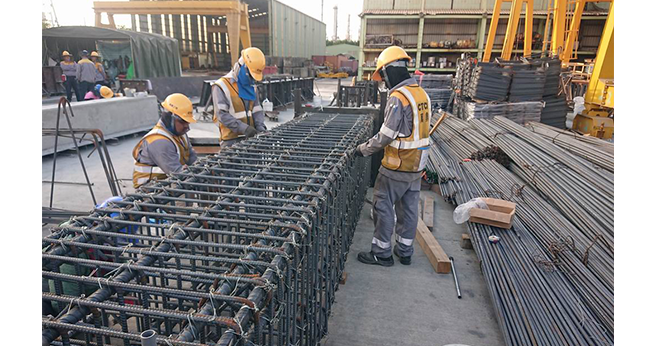
The assembly of precast column rebar cages can be performed in a horizontal position.
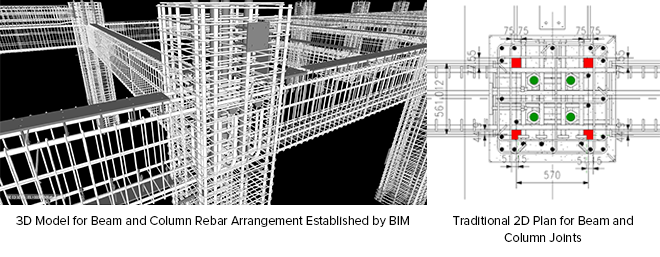
Introducing BIM Model to Eliminate Interferences
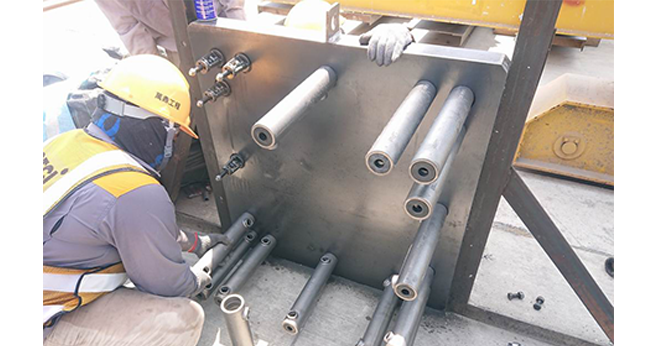
Introducing Key Technology to Overcome Column Component Connection Challenges
